
Luxury Valentino Collection Rockstud Pyramid Studs
29/09/2026
A Practical Guide to How You Verify a Valentino Garavani Bag
Proper authentication runs as a sequence and never as a glance, and the running order matters more than the average guide concedes. Run it in the wrong order and you may spend twenty minutes poring over stitching on a bag the company you think you are buying from never made. What follows is exactly that sequence, written for someone holding a bag or reading a detailed listing, with each check doing one job and then handing off. Two warnings before you begin. There is no date-code system here of the sort some buyers expect, and several supposedly decisive proofs settle nothing at all, so every step below says what that check can and cannot establish. On a high-value purchase, you still want a professional authentication service; this guide only helps you decide when to pay for one.
Step 1. Identify the maker before anything else
This step goes first because a mistake here cancels out everything downstream. The Valentino name covers two unrelated companies: the Rome couture house founded in 1960, whose leather goods are stamped VALENTINO GARAVANI, and Mario Valentino S.p.A., founded in Naples in 1952 as a leather goods and footwear house, selling as Valentino by Mario Valentino. Under a 1979 coexistence agreement, the couture house is bound by contract to use GARAVANI alongside VALENTINO on leather goods and their advertising, which is the whole reason that second word appears. A real Mario Valentino bag fails every remaining check here and is nonetheless completely authentic, and buyers get mis-sold in both directions. Check the branding first of all, name the company you are dealing with, and leave the real-or-fake question until after that. If the outside says only Valentino and the inside says Mario Valentino, what you have is an authentic bag from the Naples company, not a fake valentino garavani bag.
Step 2. Read the interior tag one word at a time
The interior tag is the highest-value single check, and it rewards patience. On a genuine piece you should see VALENTINO and GARAVANI in capitals together with MADE IN ITALY, since Italian manufacture is stated on the brand’s own product pages. Check the attachment before the wording: flat, sewn on all four sides, no lifted corner and valentin-outlet.com no adhesive anywhere. Now move to the lettering: the weight of the type should not vary from character to character, and the impression should be even, not blurred, doubled or patchy in depth. Counterfeit tags often get the words right and the pressure wrong, so the physical quality of the stamp counts for as much as the text. If the tag is missing, or names only one of the two words, regard it as a serious concern.
Step 3. Serial numbers are evidence; date codes do not exist here
Serial numbers do turn up, generally on a tag inside an interior pocket, frequently black, cream or light brown in colour. Take a picture and compare: it should be stamped as cleanly as the main interior tag. The trap is this: not every piece from the house carries one, and older models may never have carried one at all. Absence of a serial does not prove a bag is fake, and anyone claiming otherwise is oversimplifying; presence proves little either, since numbers are trivially copied. And remember that this house runs no date-code system of the kind used elsewhere: no stamped code translates into a factory and a production week. If a listing quotes you a date code, the seller is describing another brand or inventing reassurance, and both are reasons to slow down. Treat related folklore the same way: the idea that a lining colour proves authenticity is unverified and should never be decisive.
Step 4. Size up the authenticity card correctly
A card is reported to accompany these bags, showing model specification, a serial number and a Made in Italy line matching the interior tag. The source of that description is resale and authentication guides, not an official statement from the house, so treat it as market practice, nothing more. Given a card, the one useful test is agreement: card number and bag number should be the same, and a mismatch is a real warning sign. A missing card tells you nothing, since years of ownership and resale routinely separate a bag from its card. You will see sellers price a card as a certificate of authenticity, yet it is not a certificate at all, and cards copy as easily as tags. The card is worth only what it corroborates, never whether it exists.
Step 5. Read the hardware, then read the engraving
Because engraving is expensive and printing is cheap, it is the hardware that exposes counterfeit economics. On genuine pieces the logos are engraved, not printed, deep enough to feel with a fingernail and edges that hold crisp under magnification. The zip pulls observed on the line are square with rounded edges and the same deep engraving, and should have weight rather than feeling hollow. The tone of the metal is restrained, not brassy, and the observed finishes include antique-brass, light gold and platinum, so a garish yellow gold deserves a question. Make sure each piece of hardware matches the rest in tone and finish, since mismatches appear where parts were sourced separately. Plating, not solid metal, is what you are looking at, which matters a great deal for how you care for the bag.
Step 6. Go through the studs and the stitching
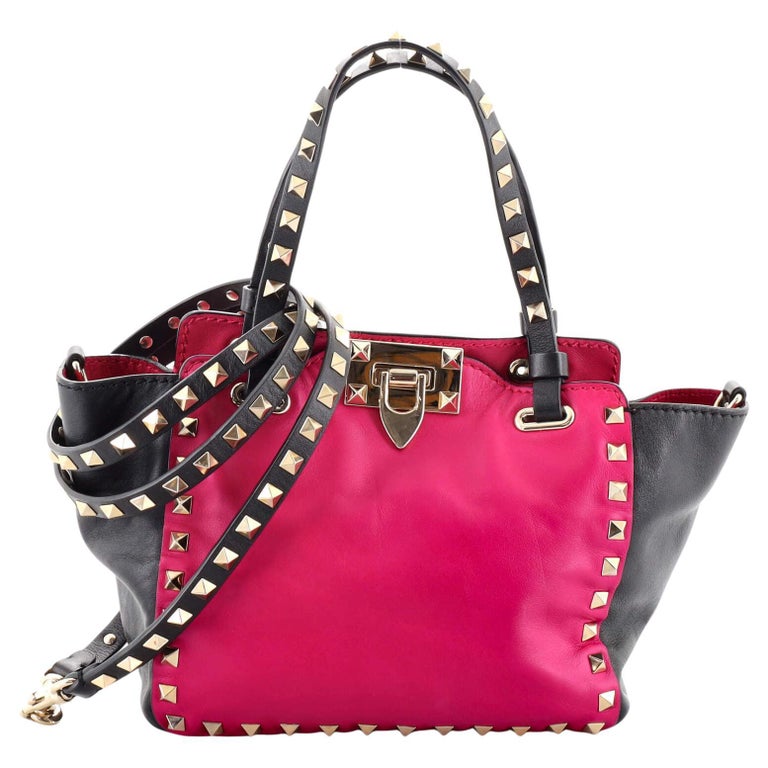
On a house whose signature is a stud, the studs themselves are a legitimate test. Each pyramid ought to match the rest in height, facet angle and flat top, and none should rock, spin or sit proud of the leather. Spacing is the second half of the test, because consistent spacing down a strap or flap edge is difficult to fake at volume and simple to check by eye. Next, work along the stitching: expect even length, seam alignment and steady density from one panel to the next. Few indicators are more reliable than wandering stitch lines, loose threads and tension that shifts across one seam, because these are the hardest details to industrialise cheaply. Give a full-length edge your attention, since inconsistency shows there.
Step 7. Run the price check and weigh the seller
Price is a check, not a courtesy, and it catches listings that survive every physical test in photographs. Set the asking price against observed 2026 market prices on the brand’s own United States site: Rockstud runs $1,250 to $2,100, Rockstud Spike $2,400 to $3,700, Locò $2,700 to $5,900, VSling $3,350 to $6,550 and VLogo Signature $650 to $3,750. On the pre-owned market, one major platform’s observed retention puts the house near 41 per cent of retail, with motif styles around 50 to 58 per cent, so a used valentino shoulder bag going for a tenth of retail is saying something. Apply the same rigour to the seller as to the bag: the brand’s own boutiques and webstore, or named authorised retailers such as Neiman Marcus, Bergdorf Goodman, Saks Fifth Avenue, Mytheresa, Net-a-Porter and Farfetch. Among resellers, Fashionphile, The RealReal, Rebag, Vestiaire Collective, Collector Square and 1stDibs are established platforms that run their own authentication before listing. Even a bag that passes is worth leaving when seller and price both look wrong: buy the same model somewhere accountable.
The checklist at a glance
Treat the table as summary only, never as a substitute for the steps above, since the third column is where most mistakes happen. Several checks are strong when they fail and weak when they pass, which is the asymmetry worth internalising. An absent interior tag is damning; a present one is merely encouraging. A serial that does not match is damning; the absence of a serial means very little. Keep the order intact, since settling the maker first saves you from running a checklist that cannot apply. If two or more rows come back negative, stop and pay for a professional opinion.
| The item you check | What you see on a genuine example | What a negative result really means |
|---|---|---|
| Which maker | VALENTINO GARAVANI on the leather goods | Only Valentino outside with Mario Valentino inside means a different, authentic company |
| Inside tag | VALENTINO and GARAVANI in capitals plus MADE IN ITALY, sewn on all four sides | No tag, or only one of the two words, counts as a serious concern |
| Serial number | Generally on an interior-pocket tag, cleanly stamped | Absence alone proves nothing; older models may never have had one |
| Date coding | None at all, as the house runs no date-code system | Quote a date code and the seller is describing another brand |
| Card | Reported to list model, serial and Made in Italy, matching the tag | Absence is normal, since pre-owned bags often arrive without one |
| The metal parts | Engraving rather than print, cut deep and even, tone restrained | Printing, shallowness or smudging is a strong negative |
| Stud work and seams | Uniform pyramids, regular spacing, aligned seams and consistent stitch density | Wobble, uneven gaps or wandering seams count as strong negatives |
Trao đổi về bài viết